Guide
How to Build a Bid Summary: From Direct Cost to Bid Total
The lines between direct cost and the bid total, the order they compound in, and a full worked bid summary that adds up.
By IntelCost Team · · 8 min read
The takeoff and pricing give you a direct cost. The number you submit is something else: the bid total, after general conditions, sales tax, overhead, contingency, profit and bond. The bid summary is the page that gets you from one to the other. It is short, but every line on it is a decision, and the order of the lines changes the answer. This guide walks through each line, shows how markups compound, and finishes with a full worked bid summary where every number adds up.
What a bid summary is for
A bid summary does three jobs:
- It adds what the line items leave out: taxes, time-based project costs, company overhead, risk, profit and bonds.
- It shows the logic. Anyone reviewing the bid can see each markup, what it was taken on and what it added.
- It gives one number to check. On bid day the summary is where you compare against your last similar job and where a late change to one rate flows through to the total.
Direct cost: the four cost types
Direct cost is the sum of the priced estimate lines, usually in four columns:
- Labor: your own crews, at direct or burdened rates. See burdened vs direct labor rates for what goes into each.
- Material: what you buy and install yourself.
- Equipment: owned or rented machines, fuel and operators if you price them here.
- Subcontracts: the quotes you carry, each already including the sub's own labor, material, tax, overhead and profit.
Keep the four separate in the summary. Sales tax applies to material, labor burden applies to labor, and some firms take a different profit on subcontracts than on self-performed work. None of that works if the columns are blended.
General conditions
General conditions are the job's own costs that do not belong to any one piece of work: the superintendent, project management time, the field office, temporary utilities and toilets, cleanup, dumpsters, small tools, permits, testing you are responsible for and similar items. In MasterFormat terms they sit in Division 01.
Price general conditions as an estimate of their own, mostly by time: so many months of a superintendent, so many months of a trailer. A flat percentage misses the point, because a longer schedule costs more whatever the contract value. Many firms carry them as Division 01 lines in the estimate itself. Once priced, general conditions are part of the job cost that the markups are taken on.
Sales tax on material
Sales tax on construction material depends on the state, on how the contract is written and on who the owner is. In many states a contractor on a lump-sum job is treated as the consumer of the materials and pays tax when buying them; in others, the rules differ. A tax-exempt owner does not always make your purchases exempt. Check your state revenue department's guidance for contractors, and follow any tax instructions in the bid documents.
In the summary, sales tax is taken on your own material only:
- Subcontract quotes normally include their own material tax. Do not tax them again.
- Most states do not tax your labor as a sale, but a few tax a contractor's gross receipts instead. Check yours.
- Equipment rentals can be taxable in some states. If they are, carry the tax in the equipment price or as its own line.
Tax comes before the markups because it is a cost you pay, the same as the material itself. The markups that follow are then taken on it too.
Overhead
Overhead is the cost of running the company that no single job pays for directly: the office, office staff, estimators, accounting, software and insurance not charged to jobs. The usual way to recover it is a percentage of job cost.
Work out your own from your books. For example: if the company's annual overhead is $1,200,000 and you expect $20,000,000 of job cost this year, the overhead rate is $1,200,000 / $20,000,000 = 6.0%. If your volume drops, the same overhead needs a higher rate.
Contingency and escalation
Contingency covers risk in your own estimate: incomplete drawings, quantities you could not fully measure, conditions you could not see. It is your money, not the owner's contingency, and it is not a substitute for pricing the work you can see. On hard-bid work many contractors keep it small or carry risk inside the line items instead; on negotiated work it is often shown openly.
Escalation covers prices that will rise between bid day and purchase on a long job. Price it on the material and labor that will be bought later, not on the whole job, if you can.
Owner allowances are different again. Carry them exactly as the bid documents state them, and follow the documents on whether markup is included in the allowance or added to it.
Profit
Profit is what the job is for. It is usually taken on everything above it in the summary. Two points worth knowing:
- Markup is not margin. A 10% markup on cost gives a margin of 10 / 110 = 9.09% of the price. Be clear which one your company targets.
- Profit can differ by cost type. Some firms take less on subcontracts, where their risk is lower, than on self-performed work.
Bond
The "Bond" line in a bid summary is the bond premium: what you pay your surety for the performance and payment bonds on the awarded contract. It is not the bid bond. Two different things carry the word "bond" on bid day:
- A bid bond goes in with the bid. It guarantees that if you are awarded the job, you will sign the contract and provide the performance and payment bonds. Its amount, often 5 to 10 percent of the bid on private and many state and local jobs, and at least 20 percent (capped at $3 million) on federal contracts, is a penal sum: the most the surety could owe the owner if you walk away. It is not a cost to you, and it never goes into the price. The bid bond itself usually costs little or nothing. The bid documents set the actual requirement.
- Performance and payment bonds guarantee that you will complete the work and pay your subs, workers and suppliers. You provide them after award, and their premium is a real job cost. That premium is the Bond line. On federal work, the Miller Act requires them on contracts over $150,000; most states have similar laws for public work.
Sureties usually price the premium on the contract amount, using a sliding scale: a rate per $1,000 that steps down as the contract gets larger. Your surety sets your rates from your company's financial statements, credit and record. Get the schedule from your surety, and ask how the premium is adjusted for change orders.
Worked example: a bond premium
The premium is figured on the contract value, at your surety's rates. The schedule below is made up for this example only. It is not any carrier's rate.
| Contract amount band | Example rate |
|---|---|
| First $100,000 | $25.00 per $1,000 |
| Next $400,000 (to $500,000) | $15.00 per $1,000 |
| Next $2,000,000 (to $2,500,000) | $10.00 per $1,000 |
| Next $2,500,000 (to $5,000,000) | $7.50 per $1,000 |
Say the bid before bond is $2,734,455.35:
- First $100,000: 100 × $25.00 = $2,500.00
- Next $400,000: 400 × $15.00 = $6,000.00
- Next $2,000,000: 2,000 × $10.00 = $20,000.00
- Remaining $234,455.35: 234.45535 × $7.50 = $1,758.42
- Bond premium: $2,500.00 + $6,000.00 + $20,000.00 + $1,758.42 = $30,258.42
Strictly, the premium is charged on the final contract amount, which includes the premium itself. In this example one more pass adds $30,258.42 × $7.50 / $1,000 = $226.94. Some estimators make that pass; others accept the small difference, since the premium is adjusted to the final contract amount later anyway.
The order of markups, and why compounding matters
The usual order is: direct cost, general conditions, sales tax on material, overhead, contingency, profit, then bond last. Each markup is taken on the running subtotal above it. Bond goes last because the surety charges on the full contract amount, profit included.
Compounding is not a detail. Using the job cost from the worked example below ($2,408,660.00):
- Each markup on job cost only: overhead 6% = $144,519.60, contingency 2% = $48,173.20, profit 5% = $120,433.00. Total markups: $313,125.80.
- Each markup on the running subtotal: overhead $144,519.60, contingency $51,063.59, profit $130,212.16. Total markups: $325,795.35.
The difference is $12,669.55 on the same three percentages. Neither method is wrong, but your percentages must have been set with the method you use. A profit target set on cost and applied on a compounded subtotal, or the other way round, misses by real money.
A full worked bid summary
Every number here is an example. Say a commercial job has priced direct costs of $412,000.00 labor, $538,000.00 material, $96,000.00 equipment and $1,154,000.00 subcontracts, general conditions priced at 6 months × $28,500.00 per month, and a 7.0% sales tax on material.
| Line | Calculation | Amount | Running subtotal |
|---|---|---|---|
| Labor | From the estimate | $412,000.00 | |
| Material | From the estimate | $538,000.00 | |
| Equipment | From the estimate | $96,000.00 | |
| Subcontracts | From the estimate | $1,154,000.00 | |
| Direct cost | Sum of the four | $2,200,000.00 | $2,200,000.00 |
| General conditions | 6 months × $28,500.00 | $171,000.00 | $2,371,000.00 |
| Sales tax on material | $538,000.00 × 7.0% | $37,660.00 | $2,408,660.00 |
| Job cost | $2,408,660.00 | ||
| Overhead | $2,408,660.00 × 6.0% | $144,519.60 | $2,553,179.60 |
| Contingency | $2,553,179.60 × 2.0% | $51,063.59 | $2,604,243.19 |
| Profit | $2,604,243.19 × 5.0% | $130,212.16 | $2,734,455.35 |
| Bond (P&P premium) | Example schedule above, on $2,734,455.35 | $30,258.42 | $2,764,713.77 |
| Bid total | $2,764,713.77 |
Check the total another way: $2,200,000.00 + $171,000.00 + $37,660.00 + $144,519.60 + $51,063.59 + $130,212.16 + $30,258.42 = $2,764,713.77. In this example the bid total is about 14.8% above job cost.
Each amount is rounded to the cent as it is made, and the next line is taken on the rounded subtotal, so the summary adds up exactly as printed.
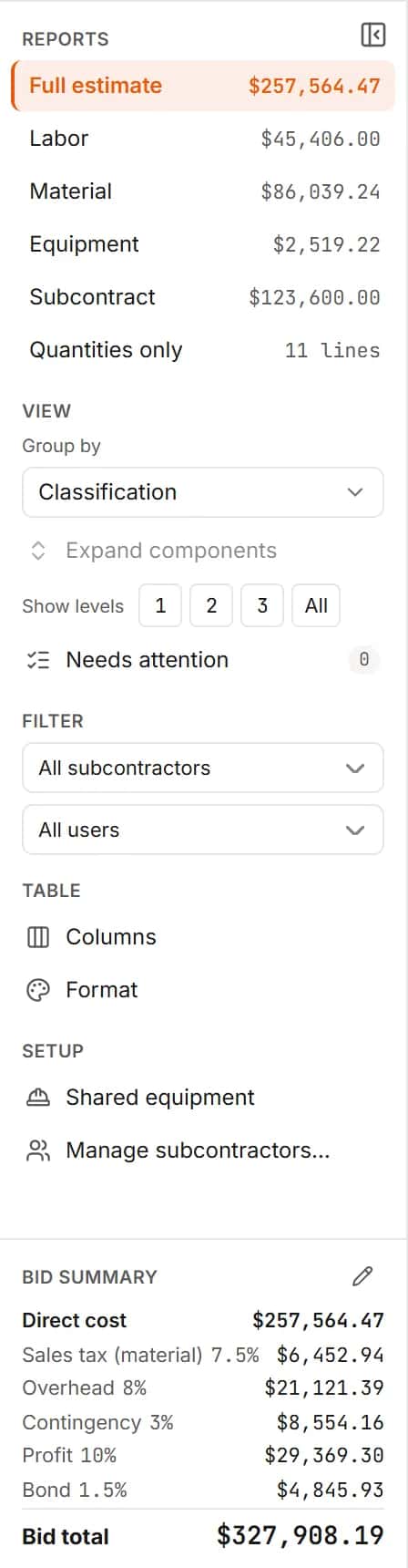
In IntelCost's Estimating tab, you price general conditions as estimate lines (Division 01), so they are already in the direct cost, and the bid summary then takes sales tax on material, overhead, any extra markups such as contingency, profit, and bond, each on the running subtotal, ending in the bid total. Workspace defaults fill in the rates for each new project, and the full estimate exports to Excel with a Bid Summary sheet.
Checks before you submit
- Direct cost matches the sum of the estimate, with no lines left unpriced or at zero quantity.
- Sales tax is on your own material only, at the right rate for the job's location and contract type.
- General conditions are priced for the current schedule, not last month's.
- Labor burden is counted once: in the rates or as its own line, never both.
- Every percentage is taken on the base your company set it for.
- The Bond line is the performance and payment bond premium from your surety's current schedule, on the full bid. The bid bond amount is not in the price.
- Unit prices and alternates required by the bid form carry their share of markup, as the bid documents require.
- The total compares sensibly with similar past jobs per square foot or per unit.